
Lesson 5 – Introduction to Green Infrastructure
LESSON SUMMARY
Students begin to synthesize the previous four lessons. They consider the amount of rain recorded in the city of Racine, calculate the amount of that rain that runs off roofs, and learn about natural and manmade structures, especially green infrastructure, that manage that runoff.
LESSON CONCEPT
The sustainability of human societies and the biodiversity that supports them require responsible management of natural resources. Scientists and engineers can make major contributions — for example, by developing technologies that produce less pollution and waste and that preclude ecosystem degradation.
LEARNING OBJECTIVES
Students can
- Perform calculations related to the amount of water collected from a roof.
- Describe the importance of wetlands.
- Describe a green infrastructure project design including the component of the water cycle (infiltration, transpiration, evaporation) it is designed to alter.
- Perform calculations to determine the size needed for a rain garden, one example of green infrastructure.
The link below will download a zipped file containing Microsoft Word documents and Microsoft PowerPoint files. Note that Microsoft Word may not consistently hold formatting. The authors chose to provide Word documents rather than Adobe pdf files so the content can be easily updated for your geographic location.
- Detailed Version of Lesson 5 – Introduction to Green Infrastructure
- Educator Background Information Introduction to Green Infrastructure – Background
- Slideshow Racine Water Trivia
- Student Handout Calculating Runoff Amounts off a Roof
- Assessment Answer Key Calculating Runoff Amounts off a Roof Answer Key
- Slideshow The Hydrologic Cycle
- Slideshow Green Infrastructure
- Student Handout Calculating Rain Garden Size
- Assessment Answer Key Calculating Rain Garden Size Answer Key
- Assessment Lesson 5 Exit Slip
The link below will open a Google form.
| ACTIVITY | TIME NEEDED |
| Lesson 5: Racine Water Trivia | 5 minutes |
| Lesson 5: Calculating Runoff Amounts off a Roof | 10 minutes |
| Lesson 5: How Wetlands Manage Runoff video | 5 minutes |
| Lesson 5: Just Breathe Transpiration Rate Demonstration | 10 minutes |
| Lesson 5: Introduction to Green Infrastructure slideshow | 5 minutes |
| Lesson 5: Calculating Rain Garden Size | 10 minutes |
| Lesson 5 Exit Slip | 5 minutes |
NEXT GENERATION SCIENCE STANDARDS
MS-ESS3-2 Earth and Human Activity
Analyze and interpret data on natural hazards to forecast future catastrophic events and inform the development of technologies to mitigate their effects.
NGSS CROSS-CUTTING CONCEPTS
- Scale, proportion, and quantity. In considering phenomena, it is critical to recognize what is relevant at different measures of size, time, and energy and to recognize how change in scale, proportion, or quantity affect a system’s structure or performance.
- Structure and function. The way in which an object or living thing is shaped and its substructure determine many of its properties and functions.
WISCONSIN MODEL ACADEMIC STANDARDS FOR ENVIRONMENTAL LITERACY & SUSTAINABILITY
ELS.EX3.B.m Explore Natural Systems Emphasis Analyze how new knowledge or technological solutions impact natural resource use, or improve environmental quality.
WISCONSIN MODEL ACADEMIC STANDARDS FOR MATHEMATICS
M.6.RP.A.3 d. Understand Ratio Concepts Use ratio reasoning to convert measurement units; manipulate and transform units appropriately when multiplying or dividing quantities.
M.8.EE.A.4 Work with Radical and Integer Exponents Choose units of appropriate size for measurements of very large or very small quantities.
WISCONSIN MODEL ACADEMIC STANDARDS FOR SCIENCE
MS-ESS3-3 Apply scientific principles to design a method for monitoring and minimizing a human impact on the environment.
SCI.ESS2.C.m The Role of Water in Earth’s Surface Processes Water cycles among land, ocean, and atmosphere, and is propelled by sunlight and gravity. Water movement causes weathering and erosion, changing landscape features.
SCI.ESS3.C.m Human Impacts on Earth’s Systems Human activities have altered the hydrosphere, atmosphere, and lithosphere which in turn has altered the biosphere. Activities and technologies can be engineered to reduce people’s impacts on Earth.
SCI.ETS2.B.m Influence of Engineering, Technology, and Science on Society and the Natural World All human activity draws on natural resources and has both short- and long-term consequences, positive as well as negative, for the health of people and the natural environment. The uses of technologies are driven by people’s needs, desires, and values; by the findings of scientific research; and by differences in such factors as climate, natural resources, and economic conditions. Technology use varies over time and from region to region.
Great Lakes Literacy Principles
- Principle 1: The Great Lakes, bodies of fresh water with many features, are connected to each other and to the world ocean.
- 1D: Rivers and streams transport nutrients, dissolved gases, salts and minerals, sediments and pollutants from watersheds into the Great Lakes.
- 1E: The Great Lakes are an integral part of the water cycle and are connected to the region’s watersheds and water systems. Changes in water systems affect the quality, quantity and movement of water, including retention time.
- Principle 6. The Great Lakes and humans in their watersheds are inextricably interconnected.
- 6C: The Great Lakes are affected directly by the decisions and actions of people throughout its watershed which includes parts of the states of Illinois, Indiana, Michigan, Minnesota, Ohio, Pennsylvania, New York, and Wisconsin, the Canadian provinces of Ontario and Quebec, and tribal lands.
- 6D: Local and national laws, regulations and resource management affect what is put into and taken out of the Great Lakes. Shoreline development and industrial or commercial activities lead to point and nonpoint source pollution.
- 6E: Coastal regions along the Great Lakes are impacted by land use decisions and natural hazards. Physical modifications (changes to beaches, shores, and rivers) can exacerbate effects of erosion, storm surges, and lake level changes.
- 6F: To ensure continued availability of Great Lakes assets, people must live in ways that sustain the lakes. Individual and collective actions are needed to effectively conserve and manage Great Lakes resources for the benefit of all.
- Principle 7. Much remains to be learned about the Great Lakes.
- 7B: Understanding the Great Lakes is more than a matter of curiosity. Exploration, inquiry and monitoring promote better understanding and protection of Great Lakes ecosystems, resources and processes.
- Principle 8. The Great Lakes are socially, economically and environmentally significant to the region, the nation and the planet.
- 8F: The Great Lakes were dramatically degraded and challenged by human endeavors in recent times. Basic ecosystem processes have been restored through individual and collective efforts. Proper foresight and informed decision making will continue to make the Great Lakes a model of environmental protection, restoration and innovation.
(Source: Ohio Sea Grant. (2013). Great Lakes Literacy: Essential Principles and Fundamental Concepts for Great Lakes Learning. OHSU-B-090. National Science Foundation, National Oceanic and Atmospheric Administration, Sea Grant Great Lakes Network, Centers for Ocean Sciences Education Excellence (COSEE))
Complete list of Great Lakes Literacy Principles available at: www.cgll.org
Evapotranspiration The process by which water is relocated from the land to the atmosphere by evaporation from the soil and other surfaces and by transpiration from plants.
Gray infrastructure Structures such as dams, seawalls, roads, pipes or water treatment plants.
Green infrastructure A set of practices that incorporates natural features to manage stormwater runoff. By increasing infiltration, transpiration and evaporation, green infrastructure can reduce runoff and improve the water quality of stormwater. Green infrastructure filters and absorbs stormwater where it falls and includes a range of measures that use plant or soil systems, permeable pavement or other permeable surfaces or substrates, stormwater harvest and reuse, or landscaping to store, infiltrate, or evapotranspirate stormwater and reduce flows to sewer systems or to surface waters.
Transpiration The process in the hydrologic cycle in which plant roots absorb water and then release the water in the form of vapor through the leaves.
Wetlands Areas where water covers the soil or is present either at or near the surface of the soil all year or for varying periods of time during the year, including during the growing season.
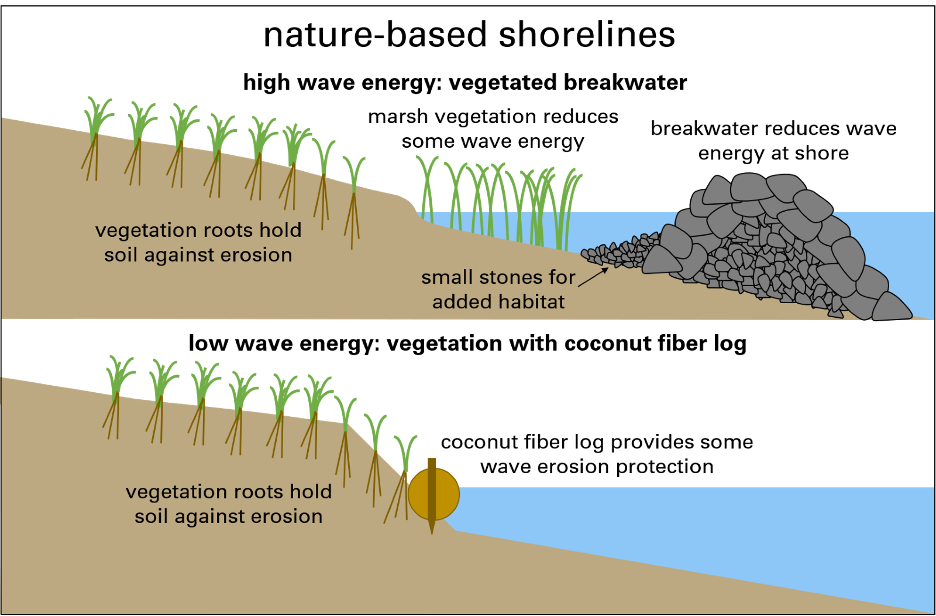
Image source: Adam Bechle, Wisconsin Sea Grant
This curriculum was prepared by Adam Bechle, Ginny Carlton, and Anne Moser under award number NA21NOS4290005 from the Great Lakes Bay Watershed Education and Training (B-WET) program of the National Oceanic and Atmospheric Administration (NOAA), U.S. Department of Commerce. The statements, findings, conclusions and recommendations are those of the author(s) and do not necessarily reflect the views of NOAA or the U.S. Department of Commerce.