
Green Infrastructure
Around the world, cities are adopting green infrastructure to help store, absorb and filter precipitation. Green infrastructure can be implemented on a small site scale, neighborhood scale or community-wide scale and performs two important functions — protecting water quality and reducing the quantity of stormwater runoff.
This website provides tools and resources related to policy, planning and mapping, financing and maintenance to help you explore how green infrastructure could be incorporated into your community.
Why Green Infrastructure?
Green infrastructure can provide many benefits to a community, including flood mitigation, improved water quality, reduced heat island effect, habitat for wildlife and socioeconomic improvements. Here is a list of resources that can help you explore and define the value of green infrastructure for your community.
American Rivers, American Society of Landscape Architects, ECONorthwest and Water Environment Federation, 2012. Banking on Green: A Look at How Green Infrastructure Can Save Municipalities Money and Provide Economic Benefits Community-wide.
Explores economic impacts of stormwater and how green infrastructure can help offset these costs.
American Rivers and Center for Neighborhood Technology, 2010. The Value of Green Infrastructure: Guide to Recognizing Its Economic, Environmental and Social Benefits.
Outlines the multiple economic, environmental and social benefits of green infrastructure and how to assess these diverse benefits to guide decision-making.
Center for Clean Air Policy, 2011. The Value of Green Infrastructure for Urban Climate Adaptation.
Identifies benefits of green infrastructure to communities to manage extremes in precipitation and temperature.
U.S. Environmental Protection Agency, 2013. Case Studies Analyzing the Economic Benefits of Low Impact Development and Green Infrastructure Programs.
Contains thirteen case studies from across the United States using various economic methods to determine cost-benefit analysis of green infrastructure and low-impact development projects.
U.S. Environmental Protection Agency, 2014. Green Infrastructure for Climate Resiliency.
Identifies how green infrastructure can help communities build climate resiliency.
Wisconsin Sea Grant, 2017. “What’s the Impact?” from Tackling Barriers to Green Infrastructure: An Audit of Local Codes and Ordinances.
Includes examples of code and ordinance amendments on the implementation of green infrastructure and reductions in stormwater runoff volume and total suspended solids.
What is Green Infrastructure?
There are many definitions of green infrastructure which have circulated in literature and dialogue in recent years. Many of these definitions focus on the varying benefits or uses of green infrastructure practices, such as enhancing biodiversity or filtrating polluted runoff. Our definition is simply stated as green infrastructure for urban stormwater management.
Wisconsin Sea Grant, 2021. Summary of Green Infrastructure Practices.
This document outlines the purpose and suitability criteria of green infrastructure practices for urban stormwater management. It also discusses the water capture capacity, costs, and management considerations of each practice, including green roofs, rain barrels, permeable pavement, stormwater trees, and the infiltrating practices of bioswales, rain gardens, native landscaping, and constructed wetlands.
Costs and Savings
The costs associated with implementing green infrastructure include the initial project costs and annual maintenance costs, but also the savings achieved by using green infrastructure over other forms of stormwater management.
Wisconsin Sea Grant, 2020. Collection of Green Infrastructure Costs.
An internally generated spreadsheet of green infrastructure costs, including capital costs, maintenance costs and material costs for eleven green infrastructure practices, accumulated from a variety of online sources.
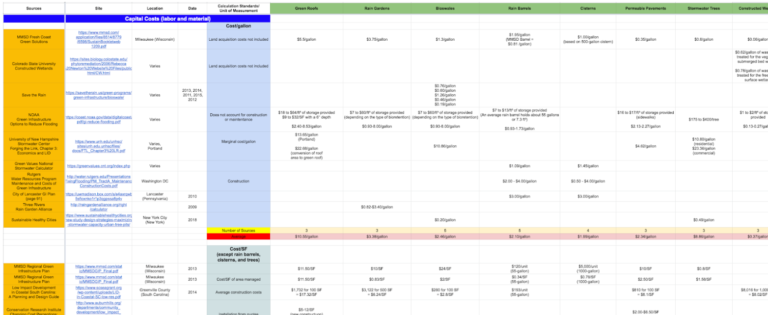
Spreadsheet of green infrastructure costs
ECONorthwest, 2011. Managing Stormwater in Redevelopment and Greenfield Development Projects Using Green Infrastructure Economic Factors that Influence Developers’ Decisions.
Covers stormwater management regulations and their impact on greenfield and redevelopment projects from the point of view of the developer.
U.S. Environmental Protection Agency, 2007. Reducing Stormwater Costs through Low Impact Design Strategies and Practices.
Includes 17 case studies of developments that incorporated low-impact development, reduced project costs and improved environmental performance.
U.S. Environmental Protection Agency, 2014. Getting to Green: Paying for Green Infrastructure: Financing Options and Resources for Local Decision-Makers.
Helps municipalities develop financial strategies and identify funding opportunities for green infrastructure.
U.S. Environmental Protection Agency, 2015. Green Infrastructure Opportunities that Arise During Municipal Operations.
Uses case studies to demonstrate how green infrastructure can be integrated into public works projects and includes discussion of cost and benefits, review plans and maintenance.
Maintenance
Most green infrastructure practices require some form of regular maintenance in order to continue to provide their many benefits. Here is a list of resources that can help you explore the maintenance requirements of green infrastructure.
American Rivers. Staying Green: Strategies to Improve Operations and Maintenance of Green Infrastructure in the Chesapeake Bay Watershed.
This report examines some of the major barriers to effective operations and maintenance of green infrastructure practices in the Chesapeake Bay region and identifies strategies and best practices that local governments, practitioners and other groups are using to develop and improve maintenance practices.
Philadelphia Water Department, 2012. Green City, Clean Waters: Green Infrastructure Maintenance Manual Development Process Plan.
This plan outlines the process of developing a green infrastructure maintenance manual, including evaluating maintenance protocols, developing protocols, checklists and schedules; maintenance contract agreements; program evaluation; and budget development.
Seattle Public Utilities, 2009. Green Stormwater Operations and Maintenance Manual.
This Seattle Public Utilities manual summarizes routine maintenance activities for the design of natural drainage system (NDS) projects and includes a chart for scheduling and performing maintenance activities and images and descriptions for vegetation, hardscape, infrastructure and infiltration rates.
U.S. Environmental Protection Agency, 2013. The Importance of Operation and Maintenance for the Long-Term Success of Green Infrastructure.
This report examines the operation and maintenance practices of 22 green infrastructure projects and highlights opportunities and challenges associated with them.
U.S. Environmental Protection Agency, 2015. Elements of a Green Infrastructure Maintenance Business Plan.
This U.S. EPA report reflects findings from the Milwaukee Metropolitan Sewerage District and local stakeholders regarding the suitability of different business models for conducting maintenance for developing a regional green infrastructure maintenance program.
Policy: An Audit of Municipal Codes and Ordinances to Tackle Barriers to Green Infrastructure
The Wisconsin Sea Grant has worked with 1000 Friends of Wisconsin, Birchline Planning, LLC, and the Milwaukee Metropolitan Sewerage District (MMSD) to create the workbook Tackling Barriers to Green Infrastructure: An Audit of Local Codes and Ordinances. This workbook leads communities through editing and updating their local codes and ordinances in order to remove some of the barriers to implementing green infrastructure.
Outreach specialist
For more information about Wisconsin’s green infrastructure, please contact Water Quality and Coastal Communities Specialist Julia Noordyk