
Invasive species guide
Invasive species can disrupt the food web, out-compete native species for food and habitat, and change an environment forever. All of the species below could pose a threat to the Great Lakes. Some are well-established, and others are just arriving. Each section includes a description, photos and a summary of potential problems caused by these invaders.
When springtime spawning stress (along with temperature fluctuations and the fish’s lack of complete adaptation to fresh water) cause die-offs, Great Lakes beaches can be covered with dead and dying fish
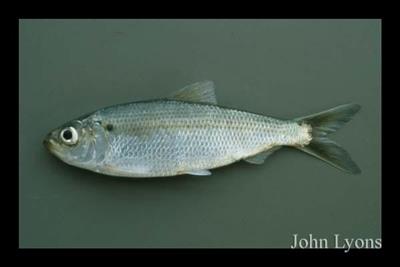
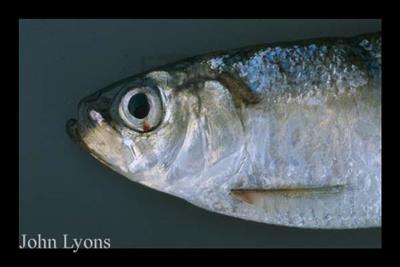
Where did the alewife come from?
The alewife is a saltwater species that is native to the Atlantic Coast. It was seen in Lake Ontario in the 1870s, and it spread to the rest of the Great Lakes after 1931 through the Welland Canal. Its abundance peaked in the 1950s as the lake trout populations decreased.
Why is it a problem?
Alewives eat the same prey, zooplankton, as many native species; they may also eat their eggs and larvae. Although alewives serve as food for lake trout, a diet high in alewives lowers reproductive success for the trout.
What does the alewife look like?
- 6-7 inches long at maturity
- Metallic, silvery-green body
- Upturned mouth
- Black spot behind large eye
- A row of scales along the belly
How can we prevent its spread?
To avoid spreading alewives, do not use them as bait outside the Great Lakes.
What habitat does it prefer?
The alewife spawns in bays and tributaries in late spring. It then moves offshore until late fall and is found near the bottom until spring.
The big head carp does not have a true stomach so it must constantly eat.
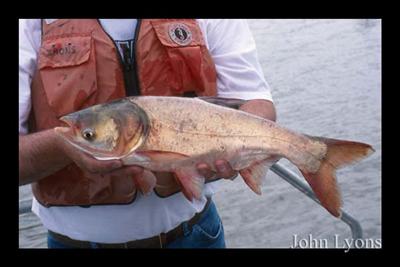
Where did the big head carp come from?
- The big head carp is native to Asia.
- It was introduced to the Mississippi River when private hatchery ponds were washed out in the state of Arkansas in the 1970s or possibly they were let go into the wild when they were no longer needed by the fish farmers.
- Appeared in open water in the early 1980s in the Ohio and Mississippi Rivers.
- Big head carp have been found in at least 19 states including Lake Erie.
Why are big head carp a problem?
- Big head carp eat blue green algae, zooplankton, and aquatic insects and larva.
- The big head carp does not have a true stomach so it must constantly eat.
- It is also thought that big head carp will compete for food with fish that are still in the larval stage, and fish populations decrease because the larval fish do not get enough food to survive.
- The big head carp is also a very high jumper. They can jump high enough to strike boaters in their boats.
- Bighead carp spawn when the water temperature is between 77-86 degrees.
- Females spawn between April and June, with the peak spawning season in late May.
- Females carry 660,000-872,000 eggs on average.
- As female big head carp get older, they increase the number of eggs they carry each time they spawn.
- Some cultures will buy two of these fish alive, one for eating, and one for release. This is not a safe practice; it will only help the populations grow.
What do big head carp look like?
- Big head carp are dark green to olive in color on their backs.
- They have gray to silvery sides, with a white to cream colored belly.
- The scales are very tiny, and the eyes are set below the midline of the body.
- The body of a big head carp is long and compressed.
- The head is very large compared to the body, this is where the fish gets its name, the big head carp.
- They can weigh from 55-110 lbs (25-50 kg).
- Big head carp can be up to 59 inches (1.5 meters) long.
- The big head carp have long gill rakers, which allow them to strain plankton from the water for food.
How do we control big head carp
The only barriers at this time that big head carp cannot get through are high dams and electric barriers.
This long-lived (15 years or more) fish feeds heavily on snails and mussels, potentially posing a threat to native mollusks.
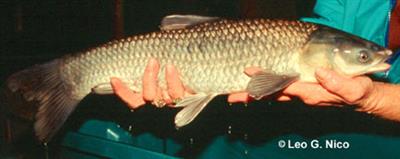
Where did the black carp from from?
The black carp is a native of eastern Asia. It was imported for snail control in catfish farms in the early 1970s.
Why is it a problem?
Black carp are voracious eaters of snails and mussels. It is likely that they will change ecosystems dramatically by reducing or eliminating populations of native mussels, many of which are endangered or threatened.
What does the black carp look like?
- Adults can grow up to 60 inches long and weigh 150 pounds.
- The fish are blackish brown to dark olive with a white belly.
- A black carp’s mouth is slightly downturned with no barbels.
- Black carp have large “chain-link” scales.
How did it spread?
Black carp introductions have come from flooded fish farms and mistakenly included in grass carp introductions.
What habitat does the black carp prefer?
It is found in large rivers, lakes and ponds. It does require rivers in which to spawn.
These silvery fish are not yet established in the Great Lakes, but if they do become established they could slow the recovery of native fish such as lake trout and sisco.
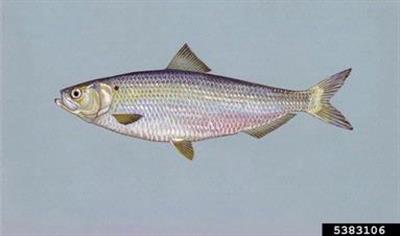
Where did the blueblack herring come from?
Blueback herring are native to the Atlantic Coast. They were stocked as food for game fish in southern reservoirs, and were discovered in Lake Ontario in 1995 after entering via the New York State Canal System.
Why is it a problem?
If the blueblack herring becomes established in Lake Ontario, they could spread to the other Great Lakes. In other areas, the introduction of blueblack herring has coincided with a decrease in game fish. It is likely the blueblack herring preys on the eggs and larvae of native fish and competes with them for zooplankton.
What does the blueblack herring look like?
- Adults are 5-12 inches long.
- Their bodies are silvery with a deep bluish-green on the back.
- They have a series of scutes (scales that are spiny and keeled) along their bellies.
- The only way to distinguish alewives from blueback herrings is to dissect them–the lining of the alewife’s body cavity is white, and the blueback herring’s is purple.
How can we prevent their spread?
Be careful not to use blueback herring for bait.
What habitat does the blueblack herring prefer?
Blueblack herrings prefer deep, open waters, and they spawn in spring to early summer in rivers and streams. In their native habitat, the fish are anadromous, meaning that they spend most of their lives in salt water but move to fresh water to spawn.
The ruffe has a lack of natural predators which creates the potential to displace other species in newly invaded areas and to cause the native fish populations to decrease.
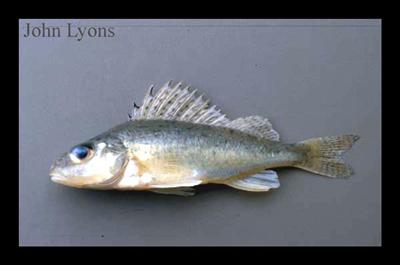
Where did the ruffe come from?
- The ruffe came to Lake Superior probably in the ballast water of a transoceanic ship in 1985.
- The ruffe is originally from fresh and brackish waters in portions of Eurasia.
- It is currently found in Lakes Superior, Huron, and Michigan.
Why is the ruffe a problem?
- The ruffe is an aggressive fish.
- It has a rapid population growth.
- The ruffe eats a variety of foods.
- The ruffe has a lack of natural predators which creates the potential to displace other species in newly invaded areas and to cause the native fish populations to decrease.
- The average female can produce 130,000 to 200,000 eggs per season.
- The ruffe can reproduce after one year in warm water temperatures and the proper location.
- Spawning usually occurs between mid-April and July, depending on water temperature and location.
What does the ruffe look like?
- The ruffe is 4 to 6 inches long (25 cm).
- The ruffe is olive-brown to golden-brown on its back, and paler on the sides with yellowish undersides.
- The ruffe is slimy and has a large spiny dorsal fin that makes is undesirable to predators.
- The ruffe is a relative of the perch and spends its days in deeper water and comes to the shallows to feed at night.
- The ruffe also has special sensory organs that detect minute movements in the water to sense predators and prey
How do we control the ruffe?
- Always drain water out of your boat, live well, and bilge before leaving water access.
- Do not throw unwanted bait into the water, place it in the trash.
- Never dump fish from one lake into another.
- Never use ruffe as bait.
Probably introduced as a bait-bucket release, the European rudd has been reported in at least 22 states.
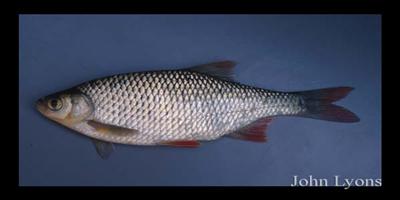
Where did European rudd come from?
- The European rudd is native to Europe and middle Asia.
- The European rudd has been reported in at least 22 states.
- It has also been reported in Canada, Morocco, New Zealand, Spain and Tunisia.
Why is it a problem?
- European rudd are voracious eaters, and through their consumption of aquatic plants, they can out-compete native species for food.
- Rudd may be putting vulnerable native aquatic plant communities at risk.
How do European rudd spread?
Rudd have been introduced by sport fishers in many bodies of water and they are also able to disperse within connected water bodies.
How do we control European rudd?
Some studies have shown that fine-mesh monofilament gill can be potentially viable way of eliminating them.
This widely established invasive competes with native species for food and shelter. Each fish can eat up to 100% of its body weight per day in aquatic plants.
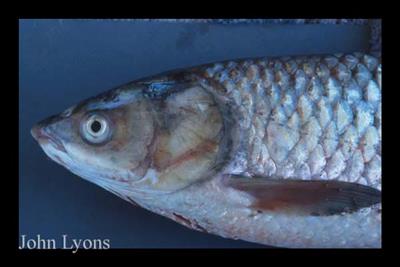
Where did the grass carp come from?
A native of eastern Asia, the grass carp was introduced in the U.S. in 1963 to control aquatic plants in fish farms. It was stocked in many locations by federal and state agencies as well as private individuals and researchers. Flooding of fish farms allowed some individuals to escape. They are now widely established.
Why is it a problem?
Grass carp eat large amounts of aquatic plants — up to 100% of their body weight per day. Large populations can remove the vegetation other fish need for food, shelter or spawning. Additionally, each fish can digest only about half of what it eats. The remaining material enriches the water and promotes algal blooms, which can reduce oxygen levels and water clarity. Grass carp may also carry parasites and diseases that cause problems for native fish.
What does the grass carp look like?
- Large, with mature adults up to 49 inches long and weighing 99 pounds
- Silvery dark grey body with a gold sheen on the side
- Slightly downturned mouth with no barbels
- Pointed dorsal fin with 8-10 soft rays.
- Large, “chain-link” scales
What habitat does it prefer?
The grass carp tolerates a wide range of temperatures, from freezing to over 100*F. It also can tolerate low oxygen levels and brackish water. It prefers large standing or slow-flowing water with vegetation.
This voracious predator has few natural enemies and is very difficult to eradicate once it’s established.
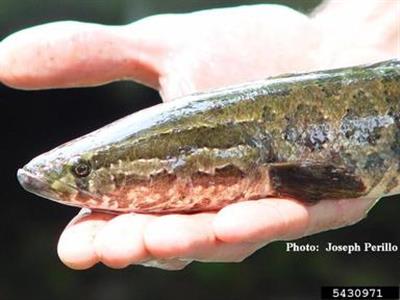
Where did the northern snakehead come from?
It is native to China and was introduced either from purchases at live-food markets or as aquarium pets. Individuals were discovered in other locations, but the first established population was found in Crofton, Maryland in 2002.
Why is it a problem?
Northern snakeheads are predators that compete with–and eat–native species for food. They can survive in a wide range of environmental conditions, including water with low oxygen levels. An established population is very difficult to eradicate.
What does the northern snakehead look like?
- Large cylindrical body, with adults up to 47 inches long
- Dark brown to tan with irregular blotches
- Long single dorsal and anal fins
- Large scales on the head give it the “snakehead” appearance
How can you distinguish it from native species?
The northern snakehead has a similar appearance to the native bowfin (Amia calva) and burbot (Lota lota). The bowfin has a short anal fin and no scales on its head, in comparison to the snakehead’s long anal fin and large scales on its head. The burbot has a single barbel in the middle of its chin, two dorsal fins and very small scales, in comparison to the snakehead’s single dorsal fin, no barbels and large scales on its head.
What habitat does it prefer?
The northern snakehead thrives in muddy or vegetated areas, with slow-moving or stagnant water.
This slender fish shimmers colorfully in water, but it fades quickly out of water and smells of cucumbers. They’ve been known to decimate walleye populations.
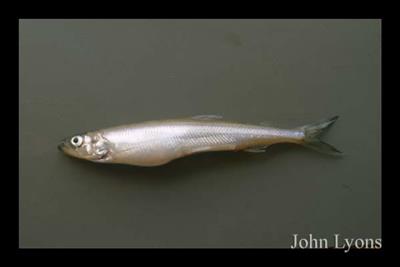
Where did the rainbow smelt come from?
Rainbow smelt are native to the Atlantic Coast and Lake Champlain. They were stocked in Crystal Lake, Mich., and escaped from there to the Great Lakes.
Why is it a problem?
Rainbow smelt prey upon many native game fish, including lake trout, cisco, whitefish and walleye. They contributed to the extinction of the blue pike.
What does the rainbow smelt look like?
- Adult size of up to 12 inches
- Colorful in water, but fades quickly out of water
- Has an adipose fin
- Has large teeth on jaws and tongue, and a large mouth
How does it spread?
This fish may be spreading to inland waters as a result of illegal stocking or release of live bait.
What habitat does it prefer?
Rainbow smelt thrive in clear, cool, deep lakes. Although they spend most of their time in deep water offshore, they spawn in early spring along shorelines, rivers and streams. They often school in open water in summer.
Redear sunfish compete with the native pumpkinseed for food (both prefer snails).
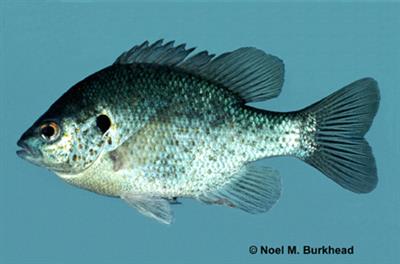
Where did the redear sunfish come from?
Native to the southeast U.S. as far north as Illinois and Indiana, the redear sunfish has been spreading via intentional stocking and aquarium releases.
Why is it a problem?
Both the native pumpkinseed (Lepomis gibbosus) and the redear sunfish are highly molluscivorous (mollusk eating). The redear sunfish has greater crushing power and is able to eat more of the snails both species need for food, which causes large reductions in pumpkinseed populations–not to mention snail populations.
What does the redear sunfish look like?
- Adults are 8-9.5 inches long
- Back end of the gill flap is black with a white border and a red spot on the tip
- Flat body, like other sunfish
- Body is olive with darker spots and flecks of red; chest is yellowish to cream
- Small mouth
- Hybridizes with other Lepomis species (other sunfish)
What habitat does it prefer?
The redear sunfish thrives in ponds, marshes and lakes with muddy or sandy bottoms. It is found in areas with slow-moving water rich in vegetation.
Round gobies reproduce very quickly, up to six times in a summer, and populations increase very quickly.
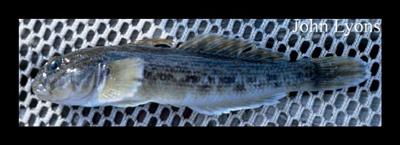
How did the round goby get here?
- The round goby appeared in the St. Clair River in 1990.
- The round goby spread to all of the Great Lakes by 1994.
- It is believed that the round goby came in the ballast water from a European ship.
- The round goby is native to the Black and Caspian Seas in Europe.
Why are round gobies a problem?
- Round gobies are very aggressive fish.
- They can displace native fish and take over habitat.
- Round gobies reproduce very quickly, up to six times in a summer, and populations increase very quickly.
- They can also survive in poor quality water, which gives them advantage over other fish.
- Round gobies are nuisance to fishermen because they steal bait off of fishhooks, eat fish eggs, and compete with small fish for food
What do round gobies look like?
- They have a single suction cup-like pelvic fin.
- Young round gobies are solid slate gray.
- Adult gobies are 3-6 inches in length, although they may get up to 10 inches long.
How do we control round gobies?
- There is little that we can do to eliminate them once they are established.
- Always drain water out of your boat, live well, and bilge before leaving water access.
- Do not throw unwanted bait into the water, place it in the trash.
- Never dump fish from one lake into another.
- Never use round gobies as bait.
How to prevent an invasion of Asian carp into the Great Lakes has been one of the most controversial topics in the management of aquatic invasive species.
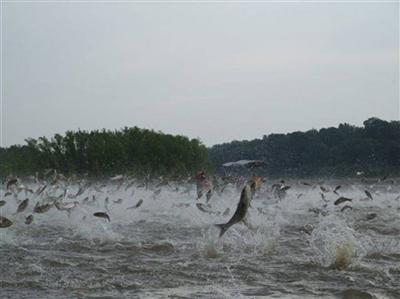
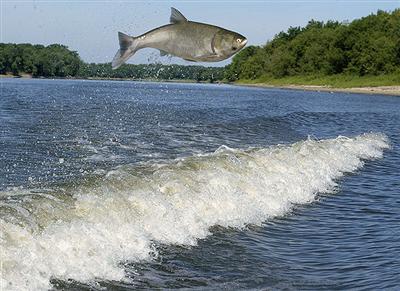
What is the Asian carp?
- There are actually several species of carp that are invasive species from Asia, including the well-known common carp and even the goldfish.
- The “Asian carp” poised to invade the Great Lakes is the silver carp (Hypophthalmichthys molitrix), and it is the Asian carp meant on this website.
Where did silver carp come from?
Flooding in the 1990s caused many ponds to overflow their banks, allowing the carp to escape into the Mississippi River basin. They have been moving north ever since.
Silver carp originated in Eurasia.
They were imported by pond aquaculturists in the 1960s and 1970s to control algae in the ponds.
Why are they a problem?
- Silver carp are large fish (up to 100 pounds) that breed very rapidly.
- These filter feeders can eat up to 40% of their body weigh daily and are likely to out-compete native species.
- When startled — and they find the noise of boat and jet ski engines startling — they leap from the water. They have knocked boaters and jet skiers unconscious and broken noses and windshields.
How can we control them?
- Silver carp as now established in the Mississippi River basin. Great effort is going into trying to keep them from invading the Great Lakes, including the dispersal barrier. See the “dispersal barrier” section for more information.
- Further efforts to control silver carp are under discussion. Check the “project updates” section for more news as it becomes available.
The sea lamprey is one of the best-known aquatic invasive species, and perhaps the most disgusting.
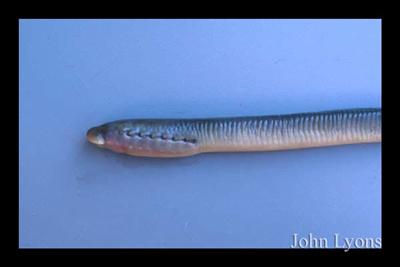
What is a sea lamprey?
- Sea lampreys are parasitic fish (in their adult form) that attach to other fish using their sucking disk. They rasp through the victim’s scales and skin, and then feed on its body fluids.
- Lampreys are members of a family of ancient fishes that were around before the time of the dinosaurs.
- Young lamprey (larvae) are small, slender creatures which feed on bottom debris and algae. This stage lasts 4-6 years.
- Adult sea lampreys are 12-24 inches long and feed entirely on other fish.
Similar species
- There are several different types of native lampreys (the silver lamprey, the American brook lamprey, the chestnut lamprey, and the northern brook lamprey). These native species do not deplete fish populations or cause the problems that sea lamprey do.
- Another look-alike is the freshwater eel, which is also native to the Great Lakes. Eels have jaws, and lampreys do not.
Where did the sea lamprey come from?
- Sea lampreys are native to the Atlantic Ocean and first entered the Great Lakes through locks and shipping canals in the 1880s.
- They were first found in Lake Ontario in 1835, Lake Erie in 1921, Lake Huron in 1932, Lake Michigan in 1936 and Lake Superior in 1946.
Why is it a problem?
- As with many invasive species, the sea lamprey entered the Great Lakes and found no natural predators, competitors, parasites or pathogens — no natural population controls.
- The top predators of the existing food web, like lake trout, were particularly susceptible to sea lamprey predation.
How do we control the sea lamprey?
- The Great Lakes Fishery Commission works with Fisheries and Oceans Canada, the U.S. Fish and Wildlife Service and the U.S. Army Corps of Engineers to control lamprey in the Great Lakes.
- There are several methods in use to control lamprey populations. The main method is the application of a pesticide called TFM that kills lamprey larvae. Although it is successful, it is also expensive.
- Another method is the use of barriers. Many different types of barriers are in use and under development — including velocity barriers, electrical barriers and adjustable crest barriers.
- Other methods of lamprey control include releasing sterile male lampreys that compete with the fertile males and therefore lower the overall reproduction rate in a particular area.
This stocky fish can really stir things up–and when it does stir up the muddy bottom of a lake, the sediments can sink back down and suffocate the eggs and newly hatched fish of native species.
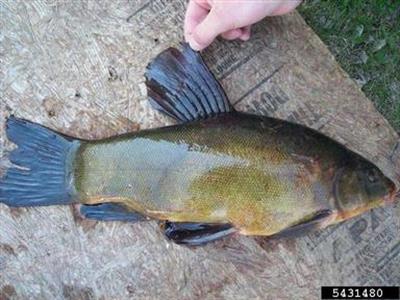
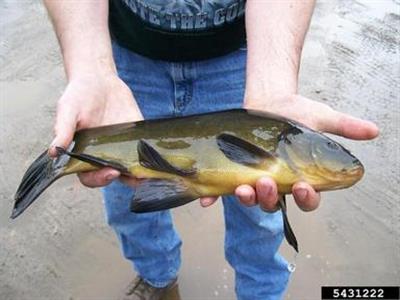
Where did the tench come from?
Tench are native to Eurasia. They were imported from Germany in 1877 by the U.S. Fish Commission for use as a food and sport fish. Tench were stocked in many lakes during the 1880s and 1890s. Although most tench populations result from stocking, some are a result of escapes.
Why is it a problem?
Tench have a tendency to stir up the muddy bottom of the lakes and rivers where they live, and the fine sediments can suffocate eggs and newly hatched fish of native species. They may also compete for food with trout and other game fish.
What does a tench look like?
- Adults up to 18 inches long
- Body is slimy and carp-shaped
- Sides are olive-green, darker at the top shading to almost golden below
- Small, red-orange eyes
- Small barbel at each corner of the mouth
- Fins are dark and rounded
What habitat does it prefer?
Tench live near the muddy bottoms of lakes and slow-moving rivers. They enjoy dense aquatic plant growth and are not generally seen in areas with very clear or fast-moving water. They become dormant in winter and stay in the mud without feeding.
This prickly little fish preys on native species and can out-compete them for food and habitat.
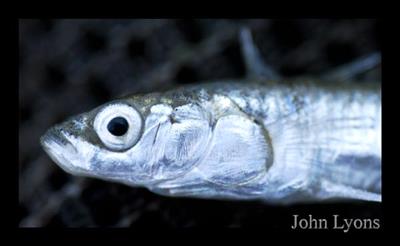
Where did the threespine stickleback come from?
The threespine stickleback is native to both coasts of the U.S. as well as Lake Ontario. It spread into Lake Michigan in the early 1980s, most likely as a result of ballast water, canals and bait-bucket transfers. It is now established in the other Great Lakes.
Why is it a problem?
This invasive stickleback eats the eggs and larvae of native fish. It also competes with them for food and habitat. Additionally, the threespine stickleback may hybridize with native sticklebacks.
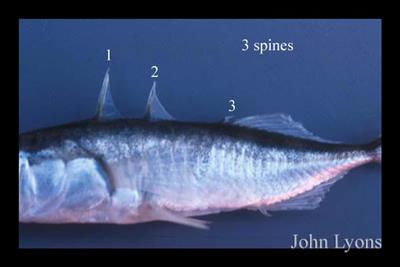
What does the threespine stickleback look like?
- Three stout dorsal spines, the first two longer than the third (see second photo)
- Adults are up to 4 inches long
- The body is silvery with dark mottling and scaleless with bony plates
- Breeding fish are colorful and defend their nests
How can we distinguish it from native species?
The native brook stickleback (Culaea inconstans) has 5-6 short dorsal spines, and the ninespine stickleback (Pungitius pungitius) has the expected nine short dorsal spines.
What habitat does it prefer?
The threespine stickleback can live in both salt and fresh water. It chooses shores of larger lakes and shallow, sandy and weedy areas in rivers, streams and ponds.
The tubenose goby is not as aggressive as the round goby, but it may still displace native species.
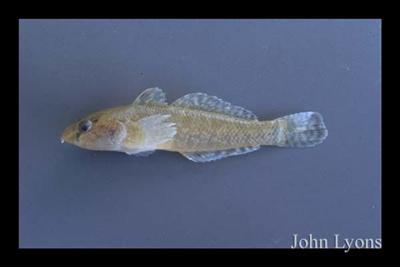
How did the tubenose goby get here?
- It arrived in the late 1990s in the St. Clair River and Michigan.
- The tubenose goby is native to the Black and Caspian Seas in Europe.
- It is believed that the tubenose goby was in the ballast water of ships coming from Eastern Europe.
Why are tubenose gobies a problem?
- They are spread from the Detroit River to western Lake Erie and to the Duluth Superior Harbor in the Great Lakes.
- They are not as aggressive as the round goby.
- The tubenose goby defends its nest sites created under rocks and logs.
- They tubenose goby typically eats aquatic invertebrates, insect nymphs, larvae, small crustaceans, worms, fish and fish eggs.
What does it look like?
- The tubenose goby is brown in color and has two dorsal fins.
- The tubenose has a tube extending from each of its nostrils.
- The tubenose goby rarely exceeds four inches (11 cm) in length.
How do we control the tubenose goby?
- There is little that we can do to eliminate them from the waters, but controlling their spread is very important.
- Inspect live bait to make sure no tubenose gobies are accidentally released.
- Discard live bait in the trash, not in the water.
- Do not transport water from one lake to another.
- Learn how to identify exotic species.
- Do not use tubenose gobies as bait.
White perch are predacious and opportunistic feeders, often feeding on the eggs of walleye.
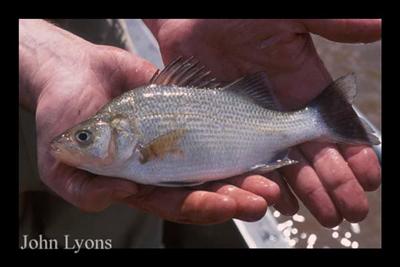
Where did white perch come from?
- White perch came from the Atlantic coastal region in brackish water.
- They first appeared in the Great Lakes in the 1940s through the Erie and Welland canals.
Why is it a problem?
- White perch are predacious and opportunistic feeders, often feeding on the eggs of walleye.
- They compete for zooplankton which may lead to algal blooms.
- White perch have hybridized with native white bass in western Lake Erie.
How do white perch spread?
- Unauthorized stocking has been a source of spread to inland waters in other states.
- White perch have been transported through boating.
How do we control white perch?
Remove fouling organisms from hull, piping, and tanks on a regular basis and dispose of any removed substances in accordance with local, state and federal regulations.
Report suspected findings in inland waters.
Education and inspection efforts can limit the spread of invasive species.
Clean ballast tanks to remove sediment regularly.
Asiatic clams are capable of self-fertilization, and one clam can lay up to 70,000 eggs a year.
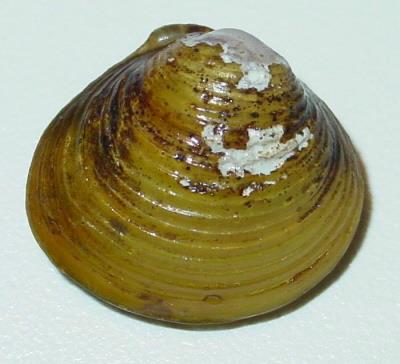
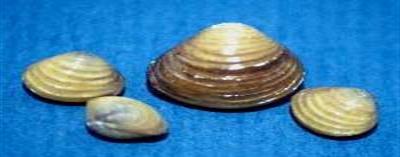
Where did the Asiatic clam come from?
- The Asiatic clam is native to Southeast Asia.
- It is also indigenous to parts of central and eastern Australia, Africa and the Mediterranean.
- It was first discovered in the United States in 1938, and it had found its way into most of the Mississippi River Basin by the 1970s.
What does the Asiatic clam look like?
- It is 1-2 inches long.
- It has a yellowish to blackish-brown thick, triangular shell with heavy, distinct, evenly spaced growth rings.
What habitat does it prefer?
- The Asiatic clam lives in brackish to freshwater rivers, lakes, streams, canals and reservoirs.
- It lies on or slightly buried in silt, sand or gravel-bottomed areas.
- It prefers moving water with high oxygen levels and has no tolerance for polluted or near-freezing water.
Why is it a problem?
- The Asiatic clam is capable of self-fertilization and one clam can lay up to 70,000 eggs a year.
- Because they are so prolific they compete with native species for food and space.
- Asiatic clams can cause major biofouling in power plants, water treatment systems and pipes.
How does the Asiatic clam spread?
- The Asiatic clam can be spread by human transport.
- They have been known to be sold for use in aquaria.
- Asiatic clams also are spread through water currents.
- On intake pipes, chemicals can be used that will kill the larva. If these chemicals were used in an open lake they would also affect fish and native mussels.
- The spread of Asiatic clams can be prevented by draining all of the water from boats, live wells and bait wells.
- Thoroughly inspect your boat’s hull and trailer for any Asiatic clam and weeds.
- Never take fish or plants from one lake and put them in another.
This invasive snail can serve as a host for parasites that may infect fish and other wildlife, compete with native snails for food and habitat, and cause mortality of largemouth bass embryos.
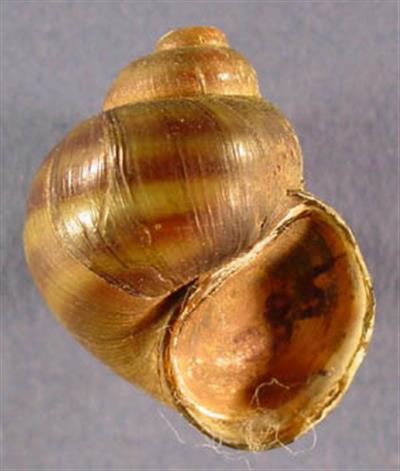
Where did the banded mystery snail come from?
The banded mystery snail is native to the southeastern part of the United States, from Florida and the Gulf of Mexico to the Mississippi River to Illinois.
How did it get its name?
Young mystery snails are born as fully formed snails that seem to appear–mysteriously–from nowhere.
Why is the banded mystery snail a problem?
- It competes with native snails for food and habitat
- It can serve as a host for parasites that can be transmitted to fish and other wildlife.
- Banded mystery snails may invade largemouth bass nests and significantly increase the mortality rate of the eggs.
The mystery snails (both Chinese and banded) don’t come from eggs. They spring forth fully formed–mysterious indeed.
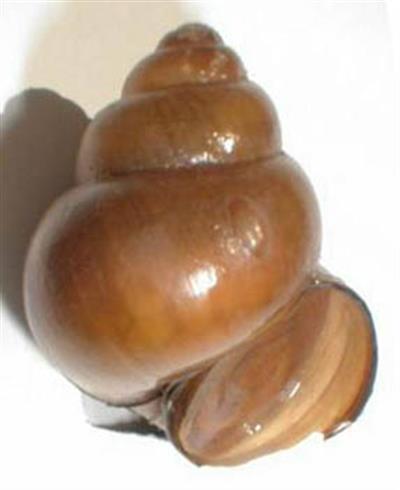
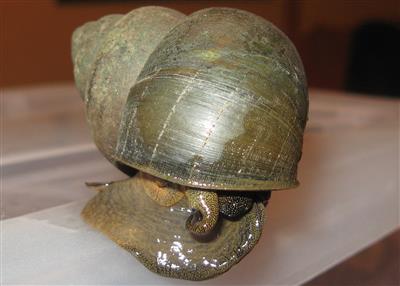
Where did the Chinese mystery snail come from?
- Native to eastern Asia
- Established on both coasts of the US by 1965
- Found in the Great Lakes in the 1940s
Why is it a problem?
Chinese mystery snails can clog water-intake pipes. They may also transmit diseases and parasites to fish and other wildlife. They compete with native snails for food and adversely affect aquatic food webs.
What does the Chinese mystery snail look like?
- Up to 2 1/4 inches
- Light brownish to olive green shell
- Six to seven whorls without banding
- Very fine growth rings
- Round or oval black lip
- May camouflage itself with a dark green covering
How do we control it?
Prevent the Chinese mystery snail from spreading by cleaning, draining and drying boats and equipment. Never release aquarium specimens into the wild.
What habitat does it prefer?
Chinese mystery snails select soft, muddy or sandy bottoms of shallow quiet waters.
These small snails are hosts to parasites that have caused the deaths of tens of thousands of diving ducks in the Great Lakes region.
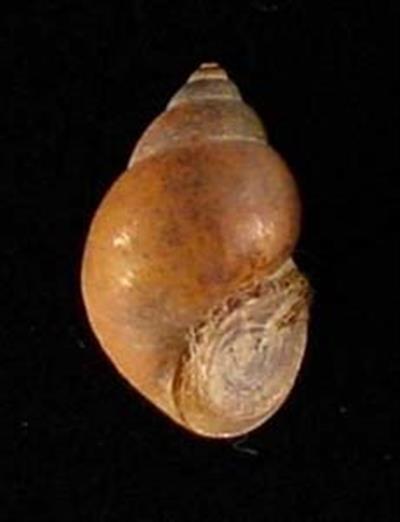
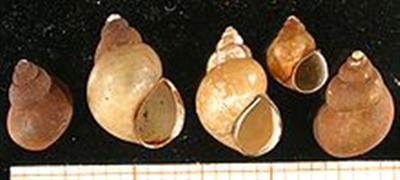
Where did the faucet snail come from?
The faucet snail is a European native that arrived in the Great Lakes in the 1870s. It was probably introduced via vegetation in packing crates or in ballast water.
Why is it a problem?
Faucet snails are hosts to parasites that have caused tens of thousands of deaths of diving ducks in Minnesota and Wisconsin. They can also clog water intake pipes, infest municipal water supplies and compete with native snails for resources.
What does the faucet snail look like?
Faucet snails are pale brown and grow up to 1/2 inch long. The shells develop 4-5 whorls, and the opening is on the right when the shell is pointed up. They have an operculum that can close the opening.
How does the faucet snail spread?
It spreads by attaching itself to boats, trailers, fishing equipment, aquatic plants or mud, and it can also live in the water of livewells, bait buckets and bilges.
How do we control it?
Populations of faucet snails can be difficult or impossible to eradicate, so preventing the establishment of a new population is important. Always follow the clean, drain dry process to avoid spreading the snails to uninfested waters.
What habitat does it prefer?
The faucet snail enjoys freshwater ponds, rivers and lake bottoms, and it attaches to objects in the water. It prefers stable water levels and migrates to muddy zones in the fall.
This native of SE Asia and China has caused major problems in South America, and it may be coming to North America via ballast water.
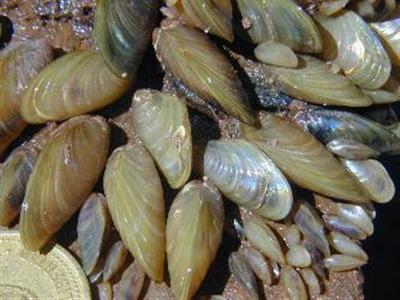
Where did the golden mussel come from?
- The golden mussel is native to China and Southeast Asia.
- It probably made its way into South America via ballast water.
- Although it has not been detected in North America, it is predicted to be a future threat.
Why is the golden mussel a problem?
- When the golden mussel invaded South America, it caused problems similar to those caused by zebra and quagga mussels in the Great Lakes region, including clogging pipes and altering the food web.
- The golden mussel can survive in a wider range of habitats than either the quagga or zebra mussel.
What does the golden mussel look like?
- Size ranges from just under 1/2 inch to 2 inches.
- The shell is a golden or yellowish color.
- The inner surface has a purple mother-of-pearl layer.
How does it spread?
- Mussels may be attached to boats, aquatic plants, nets or fishing equipment and may be transported into new bodies of water.
- Microscopic larvae can be transported in ballast water.
What habitat does it prefer?
- The golden mussel lives in brackish to freshwater.
- It attaches to hard surfaces.
- It is tolerant of water temperatures found in the lower Great Lakes region.
The New Zealand mud snail has no predators outside of New Zealand.
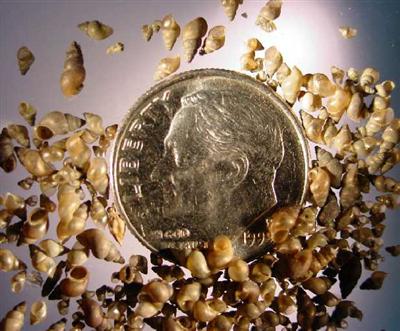
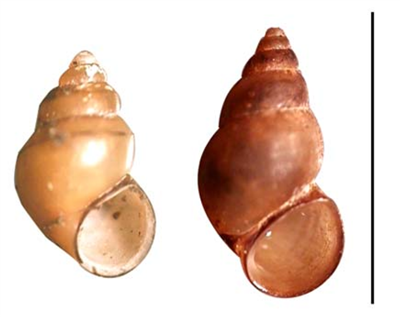
Where did the mud snail come from?
- The mud snail is native to New Zealand.
- It was first found in Idaho and Montana in 1987.
- New Zealand mud snails have been spread to Wisconsin, Minnesota, Oregon and California waters
Why is the mud snail a problem?
- The New Zealand mud snail has no predators outside of New Zealand.
- The mud snail reproduces at an alarmingly high rate and colonizes quickly.
- The mud snail competes for food with other native bottom dwelling animals and often crowds out the area, thus resulting in less food for native species.
What does the mud snail look like?
- Mature New Zealand mud snails near 5 mm in length.
- Their shells range from light brown to dark brown.
How do we control the mud snail?
- Because the introduction of the New Zealand Mud Snail has been highly successful, preventing further spread is very important.
- Education through outreach is the best way now to stop the New Zealand mud snail from spreading.
Appearing in the Great Lakes later than the zebra mussel, quagga mussels may present even more of a challenge.
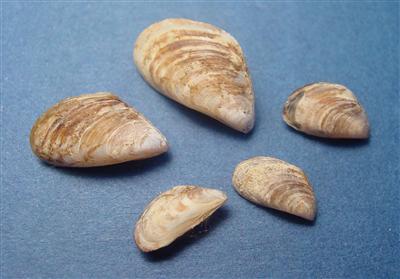
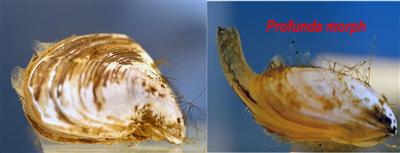
Where did quagga mussel come from?
- Quagga mussels are native to the Dneiper River drainage of Ukraine.
- They most likely arrived in the ballast water of ocean going ships.
- The quagga mussel was first sighted in the Great Lakes in September 1989.
Why is it a problem?
- Quagga are prodigious water filterers, thus removing substantial amounts of phytoplankton from the water and altering the food web.
- Quagga mussels clog water intake pipes and underwater screens much like zebra mussels.
- Quagga mussels damage boats, power plants, and harbors.
- They also destroy the native mussel population.
How do quagga mussels spread?
- Quagga mussels have spread through ballast waters from transalantic ships.
- Quagga mussels attach themselves to boat hulls and trailers and can be transported this way.
How do we control quagga mussels?
- Inspect and remove aquatic plants, animals, and mud from the boat and equipment before leaving the boat launch.
- Rinse your boat and equipment with high pressure and/or hot tap water.
The annual cost on the Great Lakes to control the zebra mussels in water intake pipes is $250 million.
Where did zebra mussels come from?
- Zebra mussels are believed to have come from the Caspian Sea in Europe.
- They arrived in the late 1980s in the ballast water of ships.
- Zebra mussels have spread to 20 of the United States and the Provinces of Ontario and Quebec.
- First found in Lake St. Clair, they have spread south to the Gulf of Mexico and north into southern Canada.
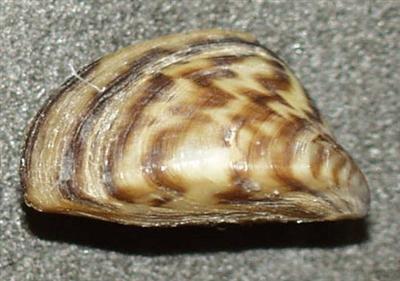
What do zebra mussels look like?
- Zebra mussels can be up to two inches (50 mm) long.
- They have striped shells that look like a zebra’s stripes, which is how they get their name.
- Zebra mussels can live for four to five years.
- Zebra mussels also have sticky byssal threads that they use to attach tightly to any hard surface.
Why are zebra mussels a problem?
- Zebra mussels are a problem because they filter water, up to a liter per day, to eat the plankton. Since the zebra mussels eat a lot of plankton, they compete with fish for food.
- They also clog pipes by forming colonies inside of the pipes. Then the water cannot flow through the pipes as easily.
- The cost to Great Lakes’ utilities to control the zebra mussels in water intake pipes from 1989 to 2004 was $267 million (Connelly, et al 2007).
How do zebra mussels spread?
- Zebra mussels can reproduce by the end of their first year.
- They usually spawn in the early spring until winter, when the water temperature is about 68*F.
- A fertilized egg results in a free-swimming planktonic larva called a veliger.
- Veligers are about the diameter of a human hair and are so small you can’t see them without a microscope.
- The veliger floats in a water column for 1-5 weeks and then as it grows it begins to sink and search for a hard surface on which to live and grow.
How do we control zebra mussels?
- Zebra mussels cannot be controlled in the wild.
- On intake pipes, chemicals can be used that will kill the larva. If these chemicals were used in an open lake, they would also affect fish and native mussels.
- The spread of zebra mussels can be prevented by draining all of the water from boats, live wells and bait wells.
- Thoroughly inspect your boat’s hull and trailer for any zebra mussels and weeds.
- Let equipment sit for 4-5 days or rinse with hot water.
- Never take fish or plants from one lake and put them in another.
Brazilian elodea is a popular aquarium plan that has found its way into the Great Lakes region. It crowds out native aquatic plants, degrades fish and waterfowl habitat and creates breeding grounds for mosquitoes.
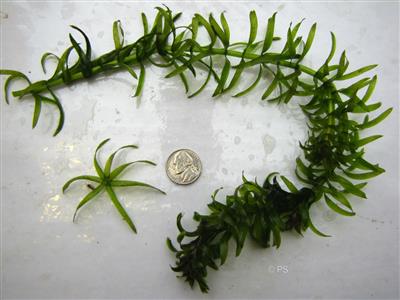
Where did Brazilian elodea come from?
It is native to South America and was probably introduced as a result of aquarium releases or accidental shipment with aquatic plants.
Why is it a problem?
Brazilian elodea makes dense mats that crowd out native aquatic plants, create breeding grounds for mosquitoes, and interfere with water-based recreation, such as swimming, fishing and boating.
What does Brazilian elodea look like?
- It is rooted on the bottom (up to 20 feet deep) or may float.
- The entire plant is submerged, except for the flowers.
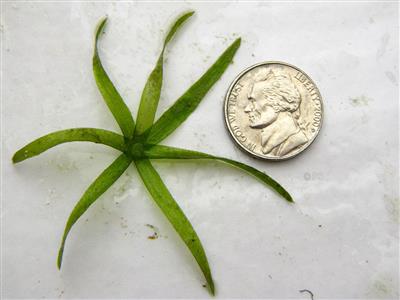
- The leaves are bright green with 4-8 whorls that are close together along them stem.
- White flowers appear in spring or early summer.
- It can be easily confused with American elodea (Elodea canadensis) or Hydrilla (Hydrilla verticillata).
How does it spread?
Fragments of the plant easily tangle with fishing gear, boats and other equipment. These fragments can grow as new plants. In its native habitat, it produces seed, but all Brazilian elodea plants are the U.S. are male and don’t produce seed.
What habitat does it prefer?
Brazilian elodea grows in slow-moving or still water. It struggles in the hot summers of the southern U.S. and prefers the northern regions.
How can you tell invasive Brazilian elodea from similar plants?
American elodea is native to the Great Lakes region, and it has smaller leaves in whorls of 2-3. Note the whorl of 7 leaves in the first and second photos of Brazilian elodea. Invasive hydrilla has obvious coarse teeth along the edges of the leaves and may produce small tubers.
This strange aquatic invasive dies off in the middle of summer–when everything else it at its peak–but it starts the season off with a major growth spurt.
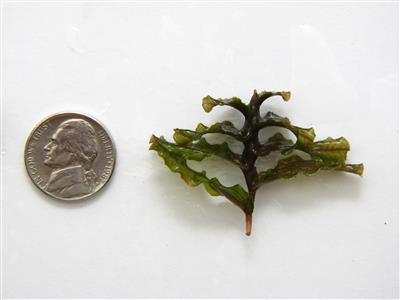
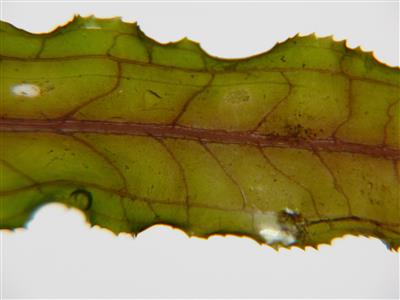
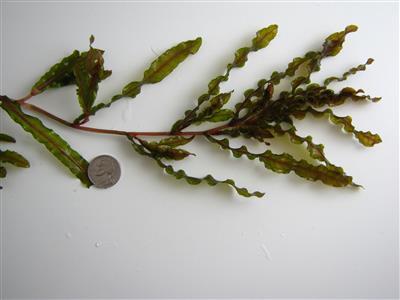
Where did curlyleaf pondweed come from?
A native of Eurasia, Africa and Australia, curlyleaf pondweed was accidentally introduced in the 1800s as an aquarium release.
Why is it a problem?
This invasive species starts out strong in the spring with early, rapid growth that can shade out native aquatic plants. When in full growth it can restrict access to docks and sport fishing. Then it dies off in mid to late summer, covering shorelines with decaying piles and reducing oxygen for fish and possibly triggering algal blooms when it decays in the water
What does curlyleaf pondweed look like?
- Leaves are oblong, reddish-green and wavy. Leaf edges are finely toothed.
- Stems are flat, 1-3 feet long and reddish brown.
- The plant grows to depths of 15 feet and drops to the lake bottom in midsummer.
How does it spread?
Curlyleaf pondweed spreads by plant fragments or rooted sections that grow right along the soil surface called “rhizomes.” New plants may also form under the ice in winter.
What habitat does it prefer?
Preferred habitats include shallow, soft bottoms of clear or polluted water bodies. Curlyleaf pondweed is tolerant of low light and low temperatures.
How can curlyleaf pondweed be distinguished from other similar plants?
Its life cycle is unusual enough to help identify it–curlyleaf pondweed is often the first species to appear when the ice melts and it dies back in midsummer.
Just a single two-inch fragment of Eurasian watermilfoil is all it takes to start a new plant.
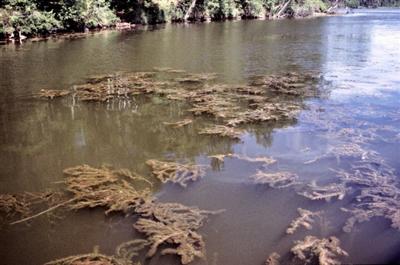
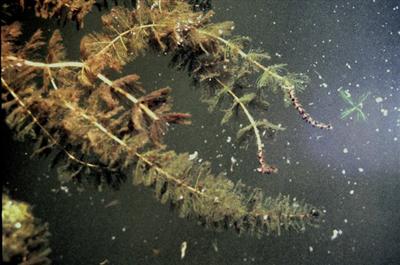
Where did Eurasian watermilfoil come from?
- Eurasian watermilfoil was introduced to the United States in the 1940s as a decoration in aquariums. It may have been dumped into a lake or pond which started the spread.
- It is native to Europe, Asia and North Africa.
Why is it a problem?
- Eurasian watermilfoil grows so fast that it can reduce the amount of light in a lake or pond, and this will shade out the other native aquatic plants.
- Dense beds of Eurasian watermilfoil create more hiding spaces for the small fish, so they are harder for the larger fish to catch. When there are lots of little fish, they may not have enough to eat so they stay small, called stunting.
- Eurasian watermilfoil can reproduce very fast, and all it takes is a two-inch fragment of a broken stem to start a new plant.
What does it look like?
- When removed from the water, Eurasian watermilfoil is limp and soft, while northern watermilfoil, which is a native plant, is hard and bristly
- Eurasian watermilfoil has 12-21 leaflet pairs, while northern watermilfoil only has 5-10 leaflet pairs.
How do we control it?
- The northern watermilfoil weevil usually eats northern watermilfoil, but it likes Eurasian watermilfoil much better.
- Herbicides can be used, but they will also kill the native plants.
- It can also be cut, but all of the plant must be removed from the water or it will come back very fast. All it takes is a fragment of a stem to spread.
- Inspect boats, trailers, motors, and nets for Eurasian watermilfoil.
- Never transport bait or water from one lake to another.
- Learn to identify Eurasian watermilfoil.
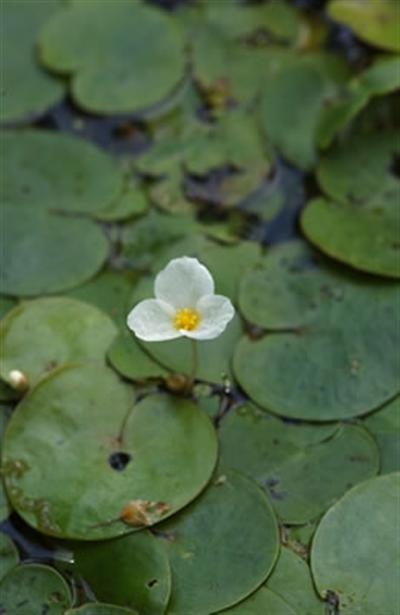
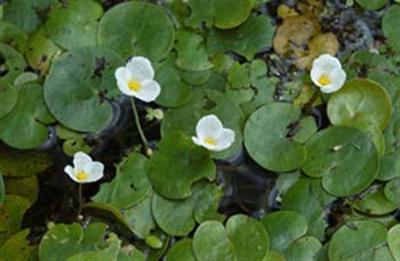
Mats of frog-bit can become so thick that boat traffic can be affected by the frog-bit tangling around boat props so that the boats can no longer move in the water.
What does it look like?
- Frogbit has round, smooth, leathery, heart-shaped leaves.
- The floating leaves have long stalks about 2 ½ inches (6 cm) long that form a rosette on a short stem.
- By mid-summer, thick mats of interlocking plants can cover the surface of the water.
- They also have a single white flower about ½ inch (1.5 cm) in diameter.
- There are also 3 petals, and on top of that a 3 ½ inch (8-10 cm) long flower stalk.
How do we control frogbit?
- Unfortunately there are no control measures at this time.
- A temporary solution may be to remove them mechanically so that boaters can use the lake.
- Inspect your boat, tackle, trailer and other equipment for plant parts.
- Drain all water from the motor, live well and bilge.
- Empty your bait bucket on land or in the trash.
- Never release bait into a lake, river or stream.
- Never move fish or bait from one lake to another.
- For small infestations, physical removal is possible by pulling them out and removing all plant parts and roots from the water.
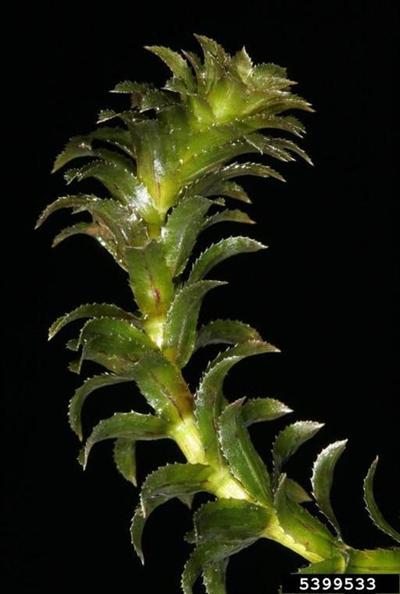
A submerged aquatic plant, hydrilla is extremely fast growing and can clog waterways and suffocate native plants.
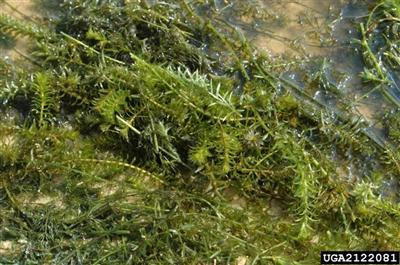
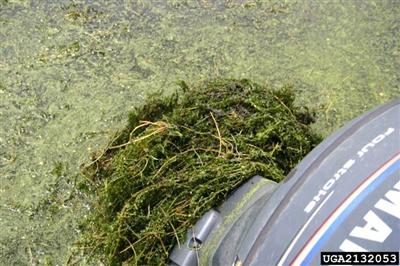
Where did hydrilla come from?
- Hydrilla is native to Australia, Africa and parts of Asia.
- Hydrilla was most likely introduced to Florida in 1960 via the aquarium trade.
Why is it a problem?
- Hydrilla can severely affect water delivery systems.
- Hydrilla creates dense mats of vegetation that destroy fish and interfere with wildlife habitats and recreation.
What does hydrilla look like?
- It has long intertwined stems that form dense mats.
- There are whorls of 4-8 pointy leaves with coarse teeth along the edges.
- In mid to late summer hydrilla produces tiny white floating flowers.
- The plant may form small tubers.
How does hydrilla spread?
- Hydrilla has extremely effective methods of propagation.
- It can sprout new plants from root fragments or stem fragments.
- Hydrilla has an extremely efficient ability to produce structures called turions and tuber. These tubers and turions can withstand ice cover, drying, herbicides, and ingestion and regurgitation by waterfowl.
- Hydrilla is readily spread by waterfowl and boating activities.
How do we control hydrilla?
- Hydrilla can be controlled by aquatic herbicides.
- Covering the sediment with an opaque fabric which blocks light from the plants can be an effective way to control Hydrilla.
How you can distinguish invasive hydrilla from similar plants?
American elodea is native to the Great Lakes region, and it has smaller leaves in whorls of 2-3. Invasive Brazilian elodea has much smoother leaves–in contrast to the obvious coarse teeth of hydrilla. Additionally, hydrilla may produce small tubers.
Common reed has replaced much of the naturally diverse wetland plant population.
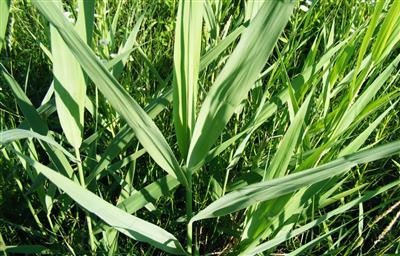
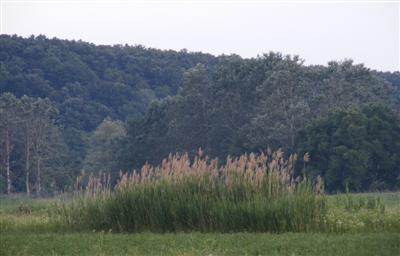
Where did phragmites come from?
Phragmites probably came to the United States via natural migration.
Why is it a problem?
- Phragmites is very aggresive and has replaced much of the native reed.
- Phragmites forms massive monocultures in otherwise biologically diverse natural wetlands.
How does Phragmites spread?
Phragmites spreads by seed and by long rhizomes.
How do we control Phragmites?
- Cutting, pulling, mowing or burning can be done and should be repeated for several years.
- Chemical herbicides can be very effective.
- Flooding for an extended period during the growing season may also be successful.
Purple loosestrife arrived in North America as early as the 1800s.
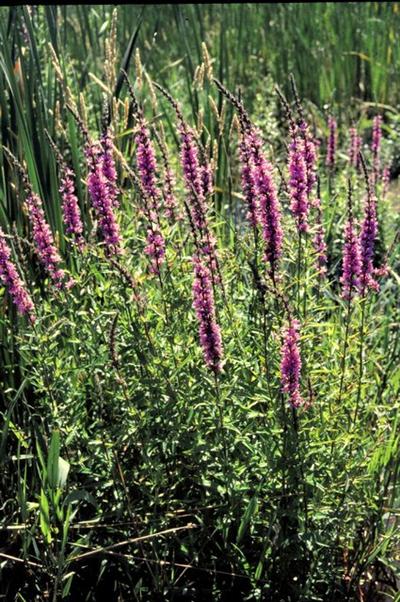
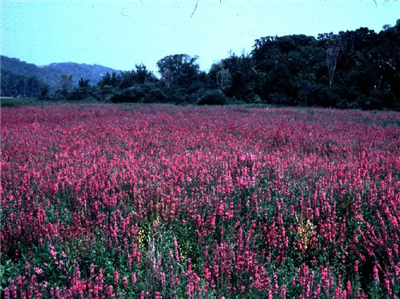
How did it get here?
- Arrived in North America as early as the 1800s.
- Settlers brought it for their gardens, and it may also have come when ships used rocks for ballast.
- Purple loosestrife has spread across the 48 United States and Canada, with the exclusion of Texas.
- It is native to Europe and Asia.
Why is purple loosestrife a problem?
- It is a very hardy perennial and aggressive plant.
- Purple loosestrife invades wetlands and moist soil areas.
- It crowds out native plants.
- It has very little food value for animals.
What does it look like?
- Purple loosestrife can be 4-7 feet tall and have up to 30 flowered spikes.
- Each plant can produce 2.5 million seeds a year.
How do we control purple loosestrife?
- Small patches can be dug up by hand and then dried and burned.
- Herbicides can be used, but they will affect other plants and possibly kill some of the good plants.
- Galerucella beetles feed only on purple loosestrife, these beetles can be released on the plants, but this can take a long time to bring an infestation under control.
This aquatic invasive has dangerously sharp-spined nuts and has colonized Lake Ontario and a significant part of the northeastern U.S.
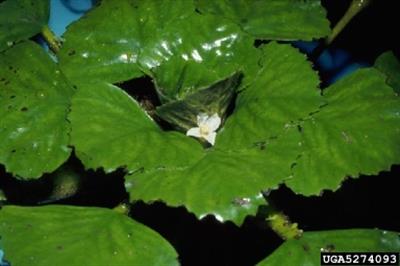
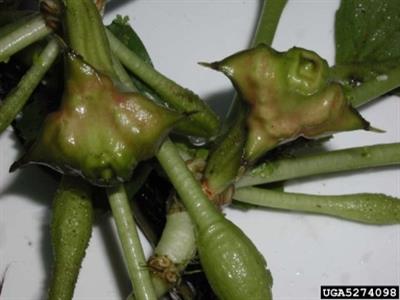
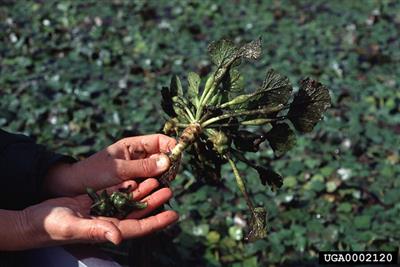
Where did the water chestnut come from?
It was introduced to the U.S. in 1874 from a botanical garden. Native to southern Europe and Asia, the water chestnut is now established in Lake Ontario and parts of the northeastern U.S.
Why is it a problem?
Water chestnuts form dense mats of vegetation that can make boating or swimming impossible. When the plant decays in the fall, the process of decomposition reduces the amount of oxygen available in the water for fish. It can also inhibit the growth of native aquatic plants and limits the amount of light that reaches the water. Additionally, the mature nuts produced by the plant have sharp spines.
What does the water chestnut look like?
- The plant consists of floating rosettes on long, cordlike stems.
- Above water leaves are triangular, waxy and toothed.
- Below water leaves are feathery and paired.
- Leaf stems have a bladder-like bulge.
- Small white flowers can appear until frost.
- The nut produced is hard and spiny.
How does it spread?
The plant reproduces both by seed and by plant fragments. Rosettes may also float to new areas of water. 1 acre can produce enough seeds to cover 100 acres the following year, and nuts can be viable for 12 years.
What habitat does it prefer?
The water chestnut enjoys full sun and quiet water. It can overwinter in frozen lakes and ponds, and it also colonizes shorelines.
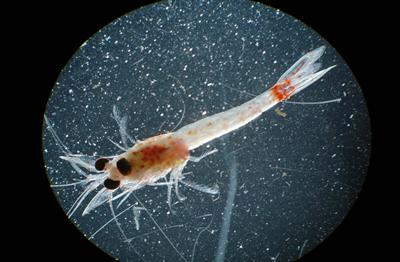
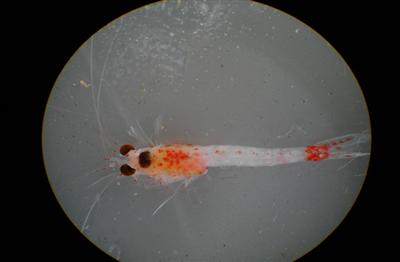
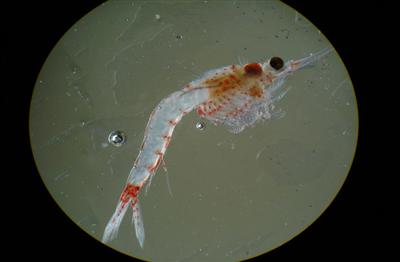
The bloody-red shrimp is one of our most recent ballast water invaders.
Where Did It Come From?
The bloody red shrimp is native to the Ponto-Caspian region of eastern Europe—the same area that zebra mussels came from. Like zebra mussels, it spread across Europe, reaching the Baltic Sea in 1992 and the United Kingdom in 2004. It was first reported in the Great Lakes by NOAA in samples collected in Muskegon, Michigan in November of 2006 in waters connected to Lake Michigan. This tiny shrimp forms swarms in excess of >1500 individuals per square meter (135 per ft2).
It has also been found in samples taken in Lake Ontario off Oswego, New York. In both locations, adults, juveniles and pregnant females were found, indicating that this species is reproducing in the Great Lakes. Finding the bloody red shrimp in two separate locations suggests that the species may be wide-spread, and experts expect that it will be seen in additional locations as people begin actively looking for it.
What Are The Impacts?
The impact of this species on the Great Lakes is yet unknown, but based on its history of invasion across Europe, significant impacts are possible. The bloody red shrimp is an omnivore; its diet includes waterfleas and algae. They may compete with young fish, while providing food for larger fish. The invasion of this species in some European
reservoirs has been documented to accelerate silica cycling, resulting in blooms of diatoms and, in some cases, plating out of silica onto pipes.
Where Is It Found?
The bloody red shrimp prefers habitats associated with hard structures or rocky bottoms and actively avoids direct sunlight. It has a unique swarming behavior unlikely to be confused with anything else in the Great Lakes. During daylight hours, it may be observed forming reddish swarms in the shadows of piers, boats or breakwalls. Swarms disperse at night, but in clear calm waters, the bloody red shrimp may be detected at night by shining a bright light on the water—the shrimp will rapidly swim away from the light.
It is unknown at this point whether zebra and quagga mussel beds in the Great Lakes will be suitable habitat for the shrimp. The species avoids soft bottoms and vegetation. In its native range, across Europe and in the Baltic Sea, the bloody red shrimp is found in water depths to 50 meters (166 feet). It seems to prefer slow-moving waters, but it has been found along rocky, wave-exposed shorelines. The shrimp is also reported to spend daylight hours hiding in rocky crevasses and boulder cavities, but it has also been observed swarming in shadowed areas near the surface by day.
What Is Its Life History?
Bloody red shrimp have an individual lifespan of about nine months, grow to adults in just 45 days, and
can produce up to four generations per year. This lifecycle is significantly more rapid than the native opossum shrimp. Females have been documented to carry up to 66 eggs in a clutch. Broods carried by females in the Muskegon population ranged from two to seven.
What Does It Look Like?
The bloody red shrimp is a mysid, a relative of the native Great Lakes opossum shrimp (Mysis relicta). Both species have stalked eyes and are generally less than 1/2 inch in length—the invader tends to be slightly smaller, though size ranges overlap. The bloody red shrimp is more red in color, and the native species is more clear, though both are quite variable. Preserved animals tend to lose coloration. The best way to tell the two species apart is by the shape of the tail (requiring a hand lens or low magnification microscope) — the native Mysis has a deeply forked tail, whereas the new invader has a flat end to its tail with two prominent terminal spines. Identifications should be confirmed by an expert as several other mysid species are also invading across Europe with significant potential to become established in North America.
Collection
LOOK for reddish swarms of quarter-to half-inch long shrimp-like animals.
LOOK during the day in the shadows of piers, boats, or breakwalls, especially after July.
LOOK at night. In clear, calm waters they may be visible as reddish ‘flashes’ reflecting as they swim away from a spotlight or flashlight.
Hemimysis are relatively strong swimmers and are not easily captured using standard scientific sampling nets or traps. Individuals may be captured using a fine mesh dip net such as used for minnows – this is clearly easiest to do when animals are swarming.
DO NOT transport live Hemimysis! Preserve Hemimysis in ethanol (grain alcohol), preferably 90% strength. 70% ethanol or rubbing alcohol are also acceptable and may be available from local pharmacies. Drain water from the specimens and place them in a small glass or plastic container and fill it with the alcohol.
These tiny little invasive zooplankton form clumps that can look and feel like gelatin or wet cotton.
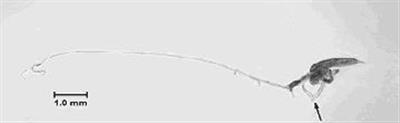
Credit: J. Liebig, NOAA GLERL
Where did the fishhook waterflea come from?
The fishhook waterflea is mostly likely a ballast water introduction. It is native to Northern Europe and appeared first in Lake Ontario. It has since spread to Lakes Michigan and Erie.
Why is it a problem?
Fishhook waterfleas consume the same plankton that larval fish eat, which threatens aquatic food webs and may limit the amount of food available for fish. Their long, hooked tails make them less appealing for fish to eat as well.
What does it look like?
Waterfleas are most noticeable when they clump together as gelatinous globs on fishing lines or other surfaces. Individually, they are 1/4 to 5/8 of an inch long, with a long tail that ends in a hook, and they have a prominent dark eyespot.
How does it spread?
In some circumstances, the eggs of dead waterfleas may survive drying and freezing and go on to establish themselves in new waters. Be sure to clean fishing gear and nets of any gelatinous blobs or cotton-like material.
What habitat does it prefer?
Waterfleas can survive in fresh to brackish water. They prefer deep water but may establish in shallower lakes as well.
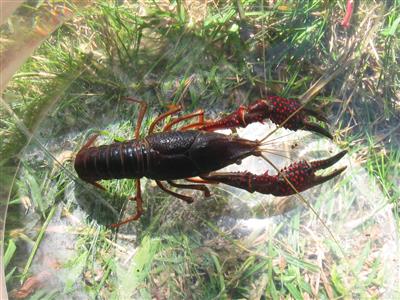
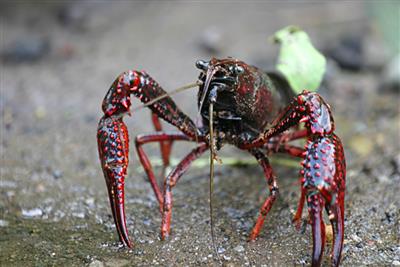
This invasive crayfish can be a host for parasites and diseases, and it aggressively competes with native crayfish and other species for food and habitat.
Where did it come from?
- The red swamp crayfish is native to the Gulf Coast and the Mississippi River drainage.
- It was probably introduced through aquaculture because it is a popular food worldwide.
Why is it a problem?
- The red swamp crayfish can be a host for parasites and diseases.
- It also aggressively competes with native crayfish and other species for food and habitat.
What does it look like?
- Including claws, the red swamp crayfish can grow up to five inches long.
- It has a dark red body and claws, with spiky, bright red bumps.
- There is also a black wedge-shaped stripe on its underside.
What habitat does it prefer?
- The red swamp crayfish lives in flowing and non-flowing fresh and salt water.
- It chooses areas of streams and ditches with organic debris.
How does it spread?
- The red swamp crayfish was probably accidentally released from aquaculture operations, bait buckets or the live-food trade.
- It can walk several miles overland to a new pond.
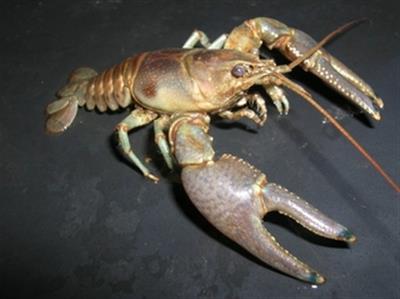
The rusty crayfish is a very aggressive species that often displaces native crayfish.
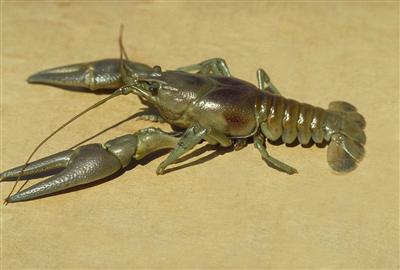
Where did the rusty crayfish come from?
- The rusty crayfish is actually native to the southern United States.
- It is believed that they were probably introduced to new areas by fishermen using them as bait.
Why are rusty crayfish a problem?
- They are an opportunistic feeder, which means they eat almost anything, including plants and small fish.
- They are a very aggressive species that often displace native crayfish.
- They also reduce the aquatic plant abundance and diversity by destroying the plants as they feed.
- Rusty crayfish mate in the late summer, early fall, or early spring, but the females wait until spring to lay their eggs. Each female can lay 80-575 eggs that will hatch in 3-6 weeks depending on the water temperature.
What do rusty crayfish look like?
- Rusty crayfish have dark rusty-colored spots on each side of their back, about where you would grab them to pick them up.
- They also have large, smooth claws that vary in color from grayish-green to reddish brown.
- The rusty crayfish also have black bands at the claw tips.
How do we control rusty crayfish?
- The best way to control rusty crayfish is to slow the spread of them to other lakes.
- Do not use them as bait.
- Inspect your boat and trailer for any exotic species and plants.
- Drain water from motor, boat, live well and bait bucket.
- Never transport them from one body of water to another.
- Learn how to identify the rusty crayfish.
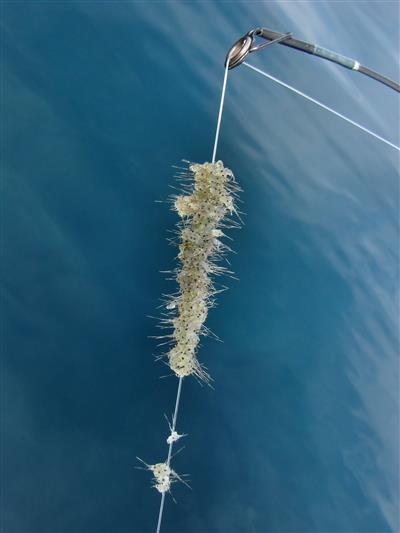
Waterfleas can clump together on fishing lines, nets and other gear, and they disrupt the food web.
Where did the spiny waterflea come from?
Native to Northern Europe, the spiny waterflea probably arrived via ballast water. It was discovered in Lake Ontario in 1982 and is now in all of the Great Lakes and some inland lakes as well.
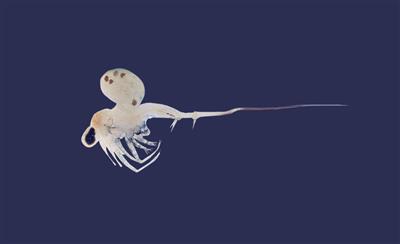
What does the spiny waterflea look like?
- Tiny, up to 1/2 inch
- Translucent and a long, sharply barbed tail spine
- A dark eyespot is prominent
- Groups can form clumps that look and feel like gelatin or wet cotton
Why is it a problem?
Waterfleas are tiny little aquatic animals (zooplankton). They are carnivorous, eating the native zooplankton that many fish also require. Additionally, young fish may be prevented from eating waterfleas because of the fleas’ barbed tail spine. Waterfleas also clump up on fishing lines, nets and other gear–jamming the first eyelet of fishing rods and damaging the drag on some reels.
How does it spread?
Waterfleas are spread by boats and fishing gear that are contaminated with females carrying eggs. Even though the females will die out of water, in some cases their eggs resist drying out and survive to form new populations.
What habitat does the spiny waterflea prefer?
The spiny waterflea prefers deep water, but it can also establish itself in shallow bodies of water.